
Recovery Beacon: AI Admissions
Recovery Beacon is an AI-powered admissions phone support system built for behavioral health centers that need to answer more calls, qualify treatment inquiries, and support safer human handoffs during high-intent admissions moments.
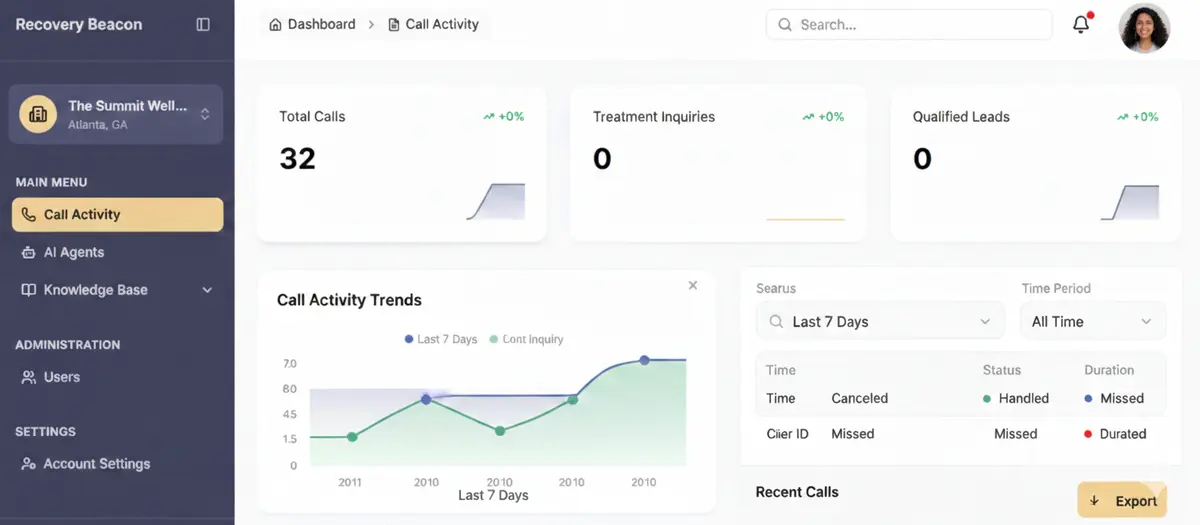
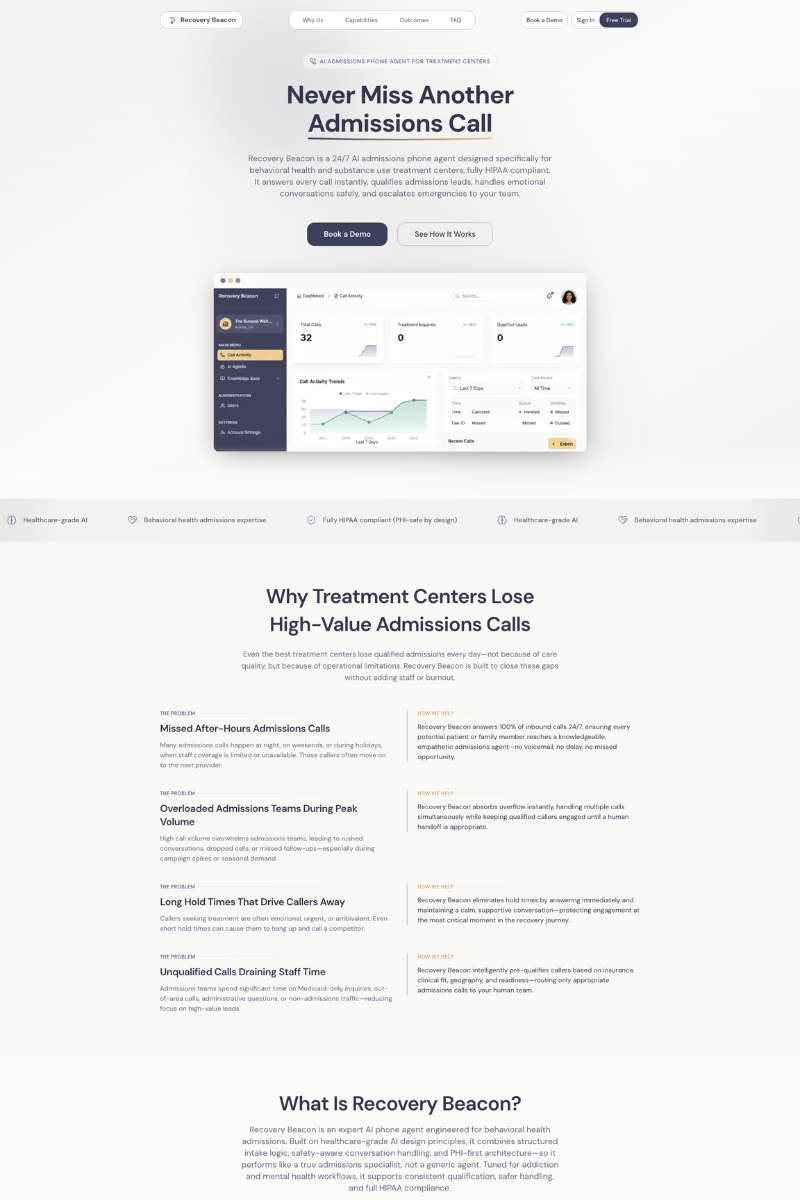
Recovery Beacon helps behavioral health providers respond to admissions calls with greater consistency, speed, and care. The system is designed to answer inbound calls 24/7, collect structured intake details, identify qualified treatment inquiries, and escalate urgent or high-value conversations to human admissions staff.
For treatment centers, Recovery Beacon supports the critical connection between marketing visibility and admissions performance. It helps reduce missed calls, organize caller information, and give human teams clearer context before they step into the conversation.
Visit Recovery Beacon.
Key Results
Stronger Admissions Call Coverage
Recovery Beacon supports 24/7 call answering so behavioral health centers can reduce missed inquiries during nights, weekends, and high-volume periods.
More Consistent Lead Qualification
The system collects key intake, insurance, payment, treatment-need, and program-fit information to help admissions teams identify stronger opportunities faster.
Safer Human Escalation
Recovery Beacon is designed to detect potential safety concerns, flag urgent conversations, and move sensitive calls toward human support.
Services Provided
- AI Phone Support
- Admissions Intake
- Lead Qualification
- CallRail Integration
- SMS Follow-Up
- Insurance Data Collection
- Warm Transfers
- Callback Scheduling
- Crisis Flagging
- Intake Summaries
- Qualification Tagging
- Performance Tracking
Key Features
24/7 AI Call Answering
Recovery Beacon answers every inbound admissions call instantly, including nights, weekends, holidays, and peak-volume periods. It is positioned around “zero missed calls,” helping treatment centers avoid voicemail, hold queues, and after-hours gaps.
Intelligent Admissions Pre-Qualification
The system screens callers based on insurance fit, treatment need, geography, level-of-care indicators, and readiness to take the next step. This helps admissions teams focus on qualified or high-potential inquiries instead of spending time filtering administrative or clearly unqualified calls.
Crisis-Safe Call Handling & Escalation
Recovery Beacon is built for sensitive behavioral health conversations. It detects indicators such as suicidal ideation, self-harm language, overdose risk, immediate danger, and severe withdrawal, then routes urgent situations to human support. The page clearly states that it does not provide medical advice or diagnosis.
Structured Intake Summaries & Human Handoff
The system collects caller details, insurance information, presenting concerns, detox or dual-diagnosis flags, urgency signals, and red-flag indicators. It then delivers a clean admissions-ready summary and supports warm transfers when a caller is qualified, safety-sensitive, complex, or requesting a human agent.
Product SUMMARY
Product Background
Recovery Beacon is an AI-powered admissions phone support system developed for behavioral health organizations that receive high-intent calls from people seeking addiction treatment, mental health care, detox, residential treatment, or dual-diagnosis support.
The system is built around a simple but important reality: admissions calls are not ordinary sales calls. A caller may be reaching out for themselves, a loved one, or a patient referral. They may be calm and prepared, or they may be emotional, uncertain, intoxicated, overwhelmed, or calling outside normal business hours.
Recovery Beacon supports this environment by acting as a structured first layer of admissions support. It answers calls, asks approved intake questions, collects relevant details, identifies qualification signals, and routes calls based on fit, urgency, and human availability.
The system does not replace clinical judgment or admissions staff. Instead, it helps human teams enter the conversation with better context and fewer gaps.
Product Challenge
Behavioral health providers often invest heavily in SEO, paid search, directories, and referral development to generate admissions inquiries. But if those calls are missed, poorly routed, or inconsistently documented, the center can lose opportunities to help people who are actively seeking care.
The main challenges include:
- Answering admissions calls after hours and during peak call windows
- Reducing missed calls from qualified treatment inquiries
- Screening callers without creating unnecessary friction
- Collecting insurance and payment details consistently
- Identifying whether the caller is a strong fit, partial fit, or not qualified
- Escalating crisis or safety-sensitive calls appropriately
- Helping admissions staff avoid spending too much time on administrative or unqualified calls
- Creating cleaner intake summaries for follow-up
For behavioral health centers, the goal is not simply to automate call handling. The goal is to support a more reliable admissions process while preserving the human judgment required for sensitive conversations.
Solution and Implementation
Recovery Beacon was designed as an AI admissions phone agent with behavioral health-specific workflows, safety boundaries, and human handoff logic.
The system can answer inbound calls 24/7 and begin a structured intake conversation. It collects caller information such as name, callback number, relationship to the patient, treatment interest, location, insurance provider, member details, self-pay ability, substance use concerns, mental health indicators, detox considerations, and prior treatment history.
From there, Recovery Beacon helps classify the call. High-value inquiries may include callers with private insurance, self-pay ability, service-area fit, and treatment needs aligned with the center’s programs. Partial-fit callers may need human review, more information, or follow-up. Unqualified calls, such as administrative requests, solicitors, Medicaid-only cases, or needs outside the center’s scope, can be routed or redirected according to approved workflows.
The system also supports warm handoffs. When a caller appears qualified, urgent, emotionally complex, or requests a person, Recovery Beacon can escalate to admissions staff and provide a structured call summary. This helps the human representative understand the caller’s situation without forcing the caller to repeat every detail.
Recovery Beacon also supports structured intake data collection, giving admissions teams a clearer picture of each caller before human follow-up begins. During the call, the system can collect contact details, caller relationship, insurance information, eligibility indicators, presenting concerns, urgency signals, detox considerations, dual-diagnosis flags, disqualifiers, and red-flag indicators. This information is organized into a clean, admissions-ready summary so the team can quickly understand the caller’s needs, determine the appropriate next step, and act without sorting through incomplete or scattered notes.
Safety is built into the system’s routing logic. Recovery Beacon is designed to detect potential indicators such as self-harm, overdose risk, severe withdrawal, domestic violence, immediate danger, or medical emergency language. In those situations, the system follows approved escalation boundaries and moves the call toward immediate human support rather than attempting clinical assessment.